

Wild Shark Cartilage
Wild Shark Cartilage
-
GMP certifiedManufactured to certified quality standards.
-
Made in New ZealandFormulated here, and New Zealand owned.
-
Free shipping over NZ $75Within New Zealand. Worldwide over NZ $250.
-
GuaranteedRead our money back guarantee
About this product
Suitable for
- Promoting healthy bones and joints
- Maintaining healthy cartilage
- Supports natural skin renewal and repair
NZ Pure Health Shark Cartilage extract is rich in nutrients such as mucopolysaccharides (chondroitin sulphate), amino acids and collagen that help maintain bones, joints and skin health.
Ingredients
Each NZ Pure Health Shark Cartilage capsule contains:
750mg Shark Cartilage powder and encapsulating materials.
This product contains no artificial flavours, colours or preservatives.

Shark Cartilage capsule
Dosage
Take one (1) or two (2) capsules daily as a dietary food supplement or as professionally advised.
Cautions
People with known allergies to seafood should avoid use.
Pregnant, breastfeeding and those on prescription medication should check with their doctor first. This product is not suitable for children.
Product information
What Is Wild Shark Cartilage?
Shark cartilage is cartilage tissue from a shark. Cartilage, a translucent elastic tissue, comprises mostly of the skeleton of embryonic and very young vertebrates. Through a process of calcification, it is transformed into bones that make up the fully developed skeletal system.
You're probably most familiar with cartilage as the "tough stuff" you don't want in your meat. You most likely refer to it as "gristle." Cartilage is apparent in the human body, as your nose and "Adam's apple."
Cartilage is also found between the segments of the spine and at the ends of long bones, where it acts as a shock absorber and a bearing surface to reduce the friction between moving parts. It is tough and elastic.
There are three types.
Fibro cartilage, the first type, is found between the backbones. It is the strongest of the three types. The second, hyaline cartilage, is gristly elastic tissue that thinly covers the moving ends of bones, connects the ribs to the breastbone and supports the nose, windpipe and part of the voice box. This type of cartilage is likely to harden in elderly people. Yellow cartilage, the third variety, is the most elastic. It is found in the external ear, Eustachian tube and throat.
One of the most interesting things about cartilage is not its form but its importance to the body, which is first apparent in the embryo. In an early fetus, there are no bones; cartilage provides the framework on which the major bones of the body, excluding the skull take form. Eventually, fetal cartilage becomes impregnated with calcium salts so that hard, or "stony," bones become apparent.
The bones of children are relatively flexible because they contain more cartilage, which is found at the tops of bones in zones called growth plates. (A theory has been postulated that newborn children are resistant to many diseases because of the large amount of cartilage present in their bodies during the early fetal and developmental stages.) Elderly people have much less soft tissue such as cartilage and a higher proportion of calcium salts, so their bones are more brittle.
A process similar to the one in which fetal cartilage develops into bone takes place throughout life whenever bones are broken. It is believed that when a bone breaks, a substance within the bone signals cells from the circulatory system to clean out the breakage site and summon undifferentiated cells to populate the site and multiply. These undifferentiated cells become chondrocytes, or cartilage cells, which produce an intertwining of cartilaginous fibres that fill the break and join the bone fragments together. Finally, the cartilage is calcified and becomes a new living bone.
Amazingly, cartilage is a tissue that performs its functions without nerves, blood vessels, or a lymphatic system. Nutrients are, therefore, not transported to cartilage via the blood or lymphatic fluid. It is this particular characteristic that seems to hold promise in battling cancer and other diseases that cause the formation of malignant tumours.
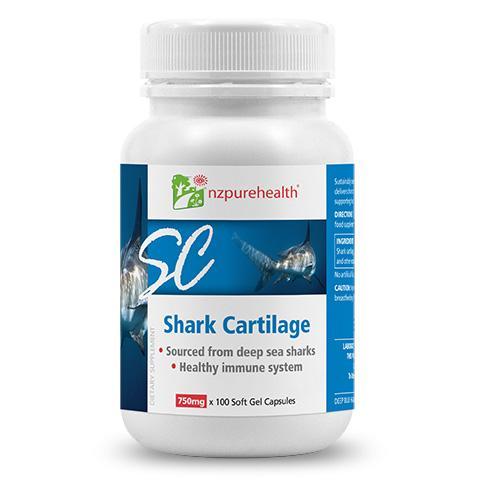
About Wild Shark Cartilage
Suitable for
- Promoting healthy bones and joints
- Maintaining healthy cartilage
- Supports natural skin renewal and repair
NZ Pure Health Shark Cartilage extract is rich in nutrients such as mucopolysaccharides (chondroitin sulphate), amino acids and collagen that help maintain bones, joints and skin health.
Ingredients
Each NZ Pure Health Shark Cartilage capsule contains:
750mg Shark Cartilage powder and encapsulating materials.
This product contains no artificial flavours, colours or preservatives.
Shark Cartilage capsule
Dosage
Take one (1) or two (2) capsules daily as a dietary food supplement or as professionally advised.
Cautions
People with known allergies to seafood should avoid use.
Pregnant, breastfeeding and those on prescription medication should check with their doctor first. This product is not suitable for children.
More Information
What Is Wild Shark Cartilage?
Shark cartilage is cartilage tissue from a shark. Cartilage, a translucent elastic tissue, comprises mostly of the skeleton of embryonic and very young vertebrates. Through a process of calcification, it is transformed into bones that make up the fully developed skeletal system.
You're probably most familiar with cartilage as the "tough stuff" you don't want in your meat. You most likely refer to it as "gristle." Cartilage is apparent in the human body, as your nose and "Adam's apple."
Cartilage is also found between the segments of the spine and at the ends of long bones, where it acts as a shock absorber and a bearing surface to reduce the friction between moving parts. It is tough and elastic.
There are three types.
Fibro cartilage, the first type, is found between the backbones. It is the strongest of the three types. The second, hyaline cartilage, is gristly elastic tissue that thinly covers the moving ends of bones, connects the ribs to the breastbone and supports the nose, windpipe and part of the voice box. This type of cartilage is likely to harden in elderly people. Yellow cartilage, the third variety, is the most elastic. It is found in the external ear, Eustachian tube and throat.
One of the most interesting things about cartilage is not its form but its importance to the body, which is first apparent in the embryo. In an early fetus, there are no bones; cartilage provides the framework on which the major bones of the body, excluding the skull take form. Eventually, fetal cartilage becomes impregnated with calcium salts so that hard, or "stony," bones become apparent.
The bones of children are relatively flexible because they contain more cartilage, which is found at the tops of bones in zones called growth plates. (A theory has been postulated that newborn children are resistant to many diseases because of the large amount of cartilage present in their bodies during the early fetal and developmental stages.) Elderly people have much less soft tissue such as cartilage and a higher proportion of calcium salts, so their bones are more brittle.
A process similar to the one in which fetal cartilage develops into bone takes place throughout life whenever bones are broken. It is believed that when a bone breaks, a substance within the bone signals cells from the circulatory system to clean out the breakage site and summon undifferentiated cells to populate the site and multiply. These undifferentiated cells become chondrocytes, or cartilage cells, which produce an intertwining of cartilaginous fibres that fill the break and join the bone fragments together. Finally, the cartilage is calcified and becomes a new living bone.
Amazingly, cartilage is a tissue that performs its functions without nerves, blood vessels, or a lymphatic system. Nutrients are, therefore, not transported to cartilage via the blood or lymphatic fluid. It is this particular characteristic that seems to hold promise in battling cancer and other diseases that cause the formation of malignant tumours.
- 4.7 out of 5From 3 customer reviews of this product
- Since 2004New Zealand owned and operated
- 230,000+ ordersSent to customers in New Zealand and worldwide
Who makes this
NZ Pure Health is a New Zealand owned company. Since 2004 we have sourced natural ingredients from New Zealand and made supplements here, and we have sent more than 230,000 orders to customers in New Zealand and around the world. Our products are made to GMP standards.
Liz LawtonSales Administrator
Liz is part of the NZ Pure Health team and writes our guides.
 GMP certifiedMade to Good Manufacturing Practice standards.
 New Zealand madeFormulated here and New Zealand owned.
 Export qualityShipped from New Zealand to customers worldwide.

Wild Shark Cartilage

-
20 Years in Market
Trusted by New Zealanders since 2004.
-
GMP Certified Quality
Manufactured to GMP certified standards, to support safety and integrity.
-
Made in New Zealand
Formulated and manufactured here, with New Zealand ingredients wherever possible.
-
NZ Pure Guarantee
Not satisfied? Our dedicated New Zealand support team is here to ensure you find the right solution for your health.


